 ENG
 INA
Temesi Village Government Holds Technical Guidance on Sustainable Moringa Processing to Address Climate Change and Boost Residents' Economy
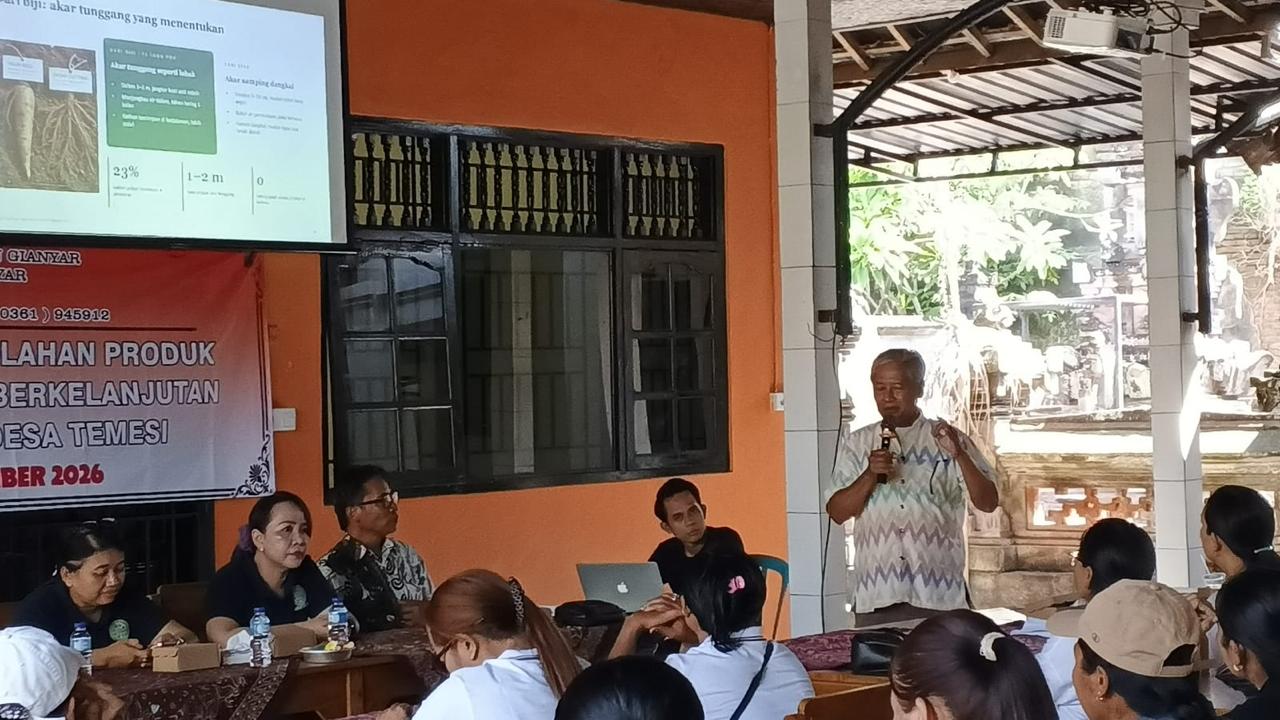
GIANYAR – The Temesi Village Government organized a Technical Guidance (Bimbingan Teknis or Bimtek) on the Sustainable Processing of Climate-Adaptive Plant Products based on moringa (Moringa oleifera) on Sunday, November 8, 2026. Held within the Temesi Village Government complex in Gianyar District, Gianyar Regency, the event featured three speakers from the Faculty of Agricultural Technology alongside moringa practitioner I Gusti Bagus Sumertana, and was enthusiastically attended by dozens of participants, predominantly local residents and female cadres of Temesi Village.
This technical guidance aimed to encourage the community to independently optimize the cultivation and processing of moringa to strengthen food security, improve family health, and unlock creative economic opportunities based on local potential. Moringa was selected as the primary commodity due to its high resilience and adaptability to climate change and extreme weather, as well as its rich nutritional profile.
The training program was conducted through comprehensive material presentations combined with interactive discussions between the speakers and participants. During the sessions, the three speakers from the Faculty of Agricultural Technology, together with practitioner I Gusti Bagus Sumertana, examined the ecological potential of moringa as a climate-adaptive crop and equipped residents with processing techniques to transform it into various environmentally friendly and competitive value-added products.
The implementation of this technical guidance also serves as a concrete step by Temesi Village toward achieving the Sustainable Development Goals (SDGs). Optimizing nutrient-rich moringa for food security and family nutrition directly supports SDG 2 (Zero Hunger) and SDG 3 (Good Health and Well-Being). Furthermore, the strong representation and active involvement of female cadres in learning value-added processing techniques to drive the local economy contribute to SDG 5 (Gender Equality), SDG 8 (Decent Work and Economic Growth), and SDG 12 (Responsible Consumption and Production). In addition, utilizing crops that are resilient to extreme weather through synergy among the village government, academics from the Faculty of Agricultural Technology, and industry practitioners exemplifies the implementation of SDG 13 (Climate Action) and SDG 17 (Partnerships for the Goals).
.jpg)
 (2).jpg)
UDAYANA UNIVERSITY